UPDATED: 02/05/2025
2 May 1881, First railway in Kimberley, a privately owned service line from the Kimberley Mine to the Floors depositing area using four locomotives and several wagons, starts operating.
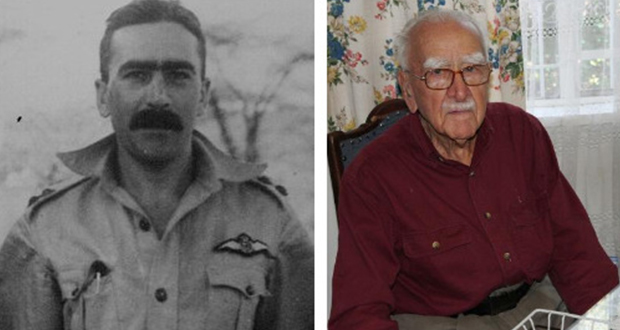
Alderman Lawrie Shuttleworth DFC
The death in Kimberley earlier today [ 2 May 2018] of Alderman Lawrie Shuttleworth DFC brought us to not only the end of an era but also the end of Kimberley’s living legend. No one person has done so much for Kimberley and its people in their lifetime as has Lawrie, giving unselfishly for much of his life over the last seven decades to the betterment of the city and the community. This without reward or honours other than knowing he had served, and served well.
Lawrence Hamilton Gordon Shuttleworth, known to his friends as “Lawrie”, was born on 18 November 1914 in Johannesburg South Africa, the third of seven sons to the union of George and Mattie Shuttleworth.
Educated at Graeme College in the Eastern Cape, he graduated from Rhodes College in Grahamstown in 1935 with a Bachelor of Commerce degree and then lectured at the Witwatersrand Technical College until the outbreak of World War II in 1939.
He qualified as a pilot with the South African Air Force in 1939 serving in East Africa with 12, 40 and 41 Squadron SAAF flying Hartebeest aeroplanes. He then came back to South Africa where, as Squadron Leader, he joined 25 Squadron SAAF on Ventura bombers protecting Allied shipping on South Africa’s coastline against German U-Boats and in middle 1944 to Italy to attack Germany and its satellite nations. The Squadron converted to Marauder bombers by end 1944 and Lawrie transferred as Squadron Leader to 15 Squadron SAAF, flying Baltimore bombers until his tour ended in March 1945. He remained with the SAAF until 1946 when he was demobilised.
During his war career he had been shot down twice, crash landed in the sea once and had logged some 1700 flying hours. Lt-Colonel Shuttleworth was awarded the Distinguished Flying Cross for his services.
It was in April 1940 that he married the love of his life, Claudia Harcourt-Baldwin, the couple having three children – Patricia, Anthony and Jennifer.
Having qualified as a Chartered Accountant by 1947 he moved to Kimberley in 1948 to practise, working and living in the diamond city for the next 70 most successful and fulfilling years.
Ignoring the essential auditing work he did for so many businesses and associations over the decades, it is what he did in his spare time for Kimberley that is well worth recording.
He joined the Rotary Club of Kimberley in May 1952, and was part of the project team that built the convalescent home known as Harmony Home, opened in 1959 when Lawrie was elected the Rotary President.
His interest in public affairs saw him elected to the Kimberley City Council in 1968, for whom he served until 1994. In 1970 he led the successful five year fight against the council’s decision to demolish the City Hall on Market Square, the Hall eventually being saved and in use to this day.
Lawrie became the Mayor of Kimberley for 1972 and 1973 and among many matters important, conferred the Freedom of the City on Harry Oppenheimer, the Chairman of De Beers Consolidated Mines.
Other projects that he was involved with, and often led, was the Market Square memorial to the pioneer column that settled in Fort Salisbury in 1890; the tourist tram service from the Town Hall to the Big Hole; the Pioneers of Aviation Museum at Alexandersfontein, the opening of Gum Tree Lodge as a youth hostel overnighter; and the building of the St Cyprian’s Cathedral tower.
In 1988 he was a Paul Harris Fellow by the Rotary Club, the highest award a Rotarian can receive. He was also made a Life Member of the Kimberley Publicity Association for his services to tourism; and was the Kimberlite of the Decade at the turn of the century. It should have been the Kimberlite of the Century.
Lawrie, passionate in all he did, was very active until recently, when failing health saw him curtail his extremely busy programme.
He died in Kimberley on the morning of Wednesday 2 May 2018.
He left his children and their families to mourn his passing.
Sincerest condolences to them all. May Lawrie RIP.
I thanked you in life. I once again thank you now that you have left us. We shall not see your like again. You were the diamond of Kimberley, a true gem for and of humanity, and our loss is most certainly heaven’s gain.
UPDATED: 02/05/2024
2 May 1881, First railway in Kimberley, a privately owned service line from the Kimberley Mine to the Floors depositing area using four locomotives and several wagons, starts operating.
(Pictured is a section of the original Kimberley Central Diamond Mining Company floors area in 1887.)
THE DIAMOND DEPOSITING FLOORS
The diamond depositing Floors were made by removing the bush and grass from a fairly level piece of ground. The land was then rolled and made as hard and as smooth as possible. The Floors were generally laid off in rectangular sections 600 yards long by 200 yards wide, each floor section holding about 50 000 loads. The depositing was done on portable lines extending from the main line on either side of the floors.

Kimberley Central Diamond Mining Company – Floors Area
A truck (cocopan) holding 16 cubic feet was used on the surface when the mines were worked from the open pit, and then were introduced in underground workings. This became the unit of measurement throughout the diamond fields. A load of blue ground weighed about 1600 pounds and covered about 21 square feet when deposited on the floors.
The blue ground, once deposited, remained on the floors without much manipulation, the sun and moisture having a wonderful effect upon it, with large pieces soon commencing to crumble. The ground was continually harrowed (ploughed) to assist in pulverization. Spans of mules were used in 1889 to draw the harrow back and forth, but steam traction engines were ordered in early 1890. The length of time necessary for the ground to be exposed before it became sufficiently pulverized depended entirely upon the season and the amount of rain that had fallen. The blue from the Kimberley Mine became well pulverized in about 3 months during summer, while that from the De Beers mine took about 6 months. The longer the ground remained exposed the better it was for washing.
Steam traction engines to harrow the floors were operational by end March 1892.
The Florianville (Floors) Township was named because it was built on the original Kimberley Mine Floors area.
In 1947 the Directors of De Beers Consolidated Mines decided “…to dispense of certain land on the former Kimberley Mine Floors to the Kimberley City Council for housing and industry, necessitating removal of the sparsely scattered blue ground.”
The Chairman of De Beers, Sir Ernest Oppenheimer, stated that “…in order to assist in the general development of Kimberley the Company has made land available…”
During 1948 and 1949 there were already 250 houses completed in Florianville (Floors), with another 250 being erected.
In 1950 the De Beers Company erected a new washing plant on the Kimberley Floors to start up washing the old blue grade dump of approximately 350 000 loads. This Plant started operating from February 1950. Thus two washing plants were operating, the smaller one on what would be the extent of Florianville Township, and the other on what would later become Colville Township.
The Floors Township was completed by 17 November 1953 and encompassed within the roads known as Recreation Road (west and south boundary), Community Road (east boundary along the railway line), and Pine Road and Farm Road (northern boundary).
Despite the fact that housing had already been built, the washing of the old Kimberley Mine Floors area continued up until 1956, some 350 000 loads being sorted by the end of 1949. By cessation of washing over 700 000 loads from the Kimberley Floors were sorted between 1947 and 1956.
The final day of washing at the Kimberley Floors plant was on 12 October 1956, two extra 8 feet Pans being erected at the Stadium Heap Plant and Kimberley Mine Plant. The Stadium Heap washing Plant for the treatment of dumps was erected in April 1953 with washing beginning the next month.
By the end of November 1957 the Grease Tables at the Floors Washing Plant (Colville) had been moved.
2 May 1881, First railway in Kimberley, a privately owned service line from the Kimberley Mine to the Floors depositing area using four locomotives and several wagons, starts operating, 1881
DID YOU KNOW
Dinner in the evenings was always entertaining and many thousands shared a meal with Cecil Rhodes, but what was worrying to all, especially his staff, was if he was sitting next to a person he considered a fool. His valet from 1886, Charlie Rickson, related that if his neighbour could not converse with him, it was quite easy for everyone at the table to see what he thought of the person’s intellect. Another habit, which was most repulsive to many at the dinner table, was that if he had an itch, and wasn’t thinking, he would just scratch himself, no matter who was at the table or surrounds. He disliked eating alone and the only times that he did so was at breakfast. Notwithstanding this habit, he was a stickler for cleanliness, and bathed and shaved every day whether in town or travelling in the veld. “He loved to have his bath in the open. It was Tony’s duty as soon as the wagons were halted to spread a waterproof sheet behind the nearest tree, to provide a bucket of water, which was placed in the centre of the waterproof sheet, and to put out Mr Rhodes’ shaving materials and a change of clothing. Rhodes then had his bath with the aid of a huge sponge, which he dipped into the bucket of water and squeezed over his body. With Rhodes as an example we always appeared fresh and clean at breakfast.” Tony would always travel with at least three dozen changes of apparel for Rhodes.
When he was happy, he would whistle, but no one could ever recall him singing, except on his deathbed when he was delirious. That he was fond of music has been well recorded, and he had his personal band at Groote Schuur, made up of coloured men who worked on the estate. It was a brass band, but when necessary for the occasion, they would bring violins and other string instruments along. Rhodes particularly liked marches and polkas and the band specialised in these tunes. He had the uncanny knack of being able to command sleep whenever the urge came upon him. On many an occasion while out shooting he would go quietly under a bush with a stone for a pillow and fall asleep. A dinner party was given in his honour, and the other guests, after waiting for a reasonable amount of time, concluded that he must have forgotten the engagement. However, after the dinner was completed, some of the guests went into the next room where they found Rhodes asleep in a chair. He had walked into the dinner party a little early and finding no one around, had gone into the room, found a chair and promptly fallen asleep.
From Kimberley Calls and Recalls on Facebook By Steve Lunderstedt
Shortlink for this post: https://www.kimberley.org.za/?p=8885